
Services-as-Software for Law Firms: The AI Playbook Nobody's Talking About
Key Takeaways
- ▸ Law firms spend 10x more on lawyers doing manual work than on technology tools that could automate it
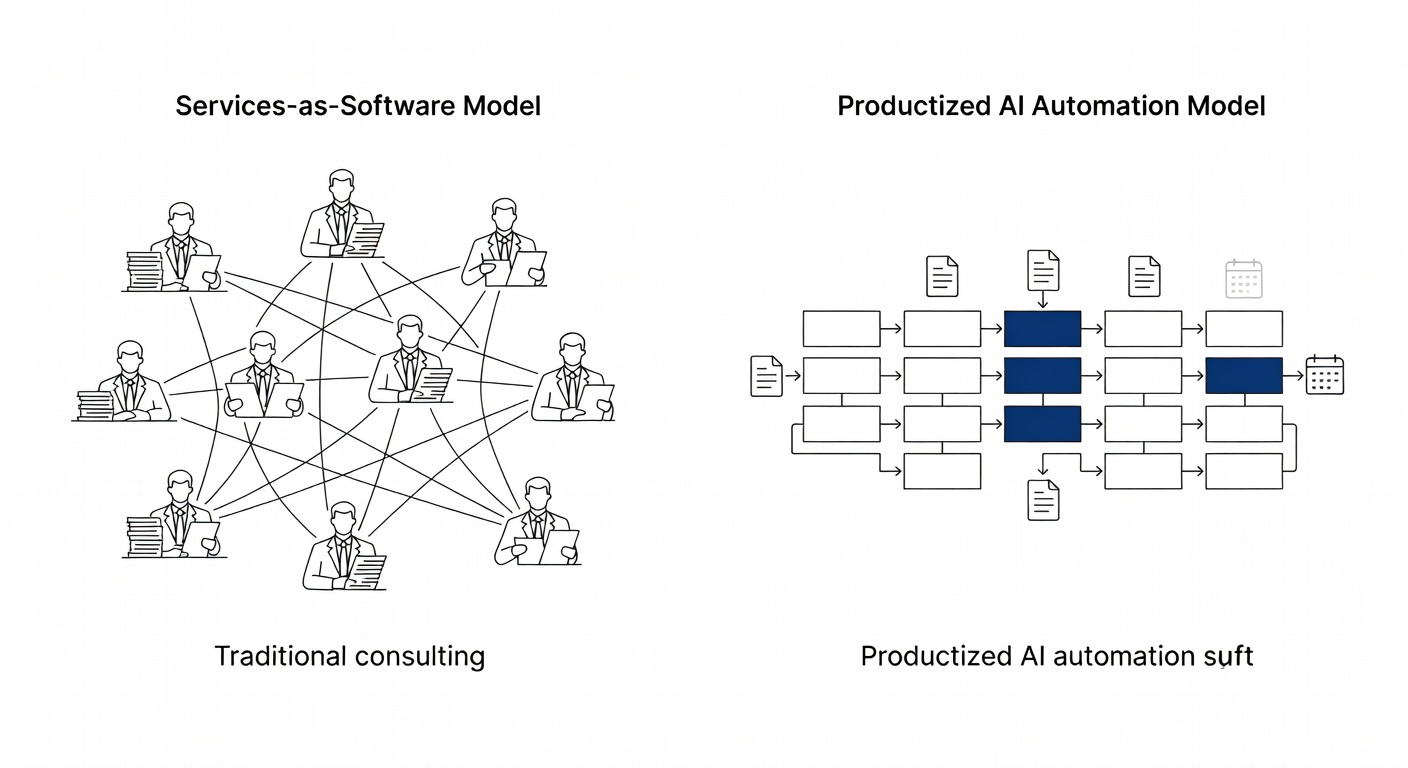
- ▸ The "services-as-software" model is replacing the consultant-to-SaaS pipeline by making services productized from day one
- ▸ AI turns every client into R&D for what to automate, funding development while delivering value
The $312,000 Question
A medium-size litigation firm pays $45K annually on technology tools. QuickBooks for billing, DocuSign for contracts, Calendly for scheduling, and about 8 other subscriptions nobody can explain why they bought.
They also pay their lawyers an average of $300K each in salary and benefits.
The technology spending looks like a cost center. The lawyer time doing work that’s already been digitized — document review, intake qualification, calendar coordination — is the real money question.
What Alex Vacca Actually Learned
Alex Vacca left a $80K/year operations job at Worldcoin to build ColdIQ — a services-as-software company that now does $7M in ARR with 400 clients and 30+ people, all bootstrapped.
His finding: “The next trillion-dollar company will sell the work, not the tool.”
For every dollar a law firm spends on technology tools, they spend six or more dollars on lawyers doing manual work that could be automated. Most founders are chasing the QuickBooks budget ($120K/year for accounting) while ignoring the accountant budget where the actual money sits.
Why Law Firms Miss This
Law firms think in terms of software products. They want to buy the tool, not build the capability. But AI changes the economics: you can now sell delivery without buying the platform first.
The traditional playbook is:
- Build a SaaS product for legal tech
- Hope it’s good enough that lawyers will switch from their current stack
- Wait years for adoption
The services-as-software playbook flips this:
- Sell implementation work as the delivery mechanism
- Every client funds research on what to automate next
- After 12-18 months, productize what you’ve already built
- Now you’re building software with real demand data
What This Actually Looks Like for a Law Firm
A firm could start by automating their intake process — not buying a chatbot that works okay, but actually implementing one, watching it fail, fixing the edge cases, then selling the same solution to other firms in their network.
Or they could automate time capture — building auto-capture from email, calendar, and document activity, then selling that capability as implementation work before productizing it.
The key difference: you’re not guessing what lawyers need. Every client pays you to learn what works and doesn’t work at real scale. That’s 18 months of market research funded by customers instead of burned on a feasibility study.
The 40% Problem That AI Solves
Current law firms have two fundamental problems:
Intake: 48% of law firms are completely unreachable by phone during intake hours. Only 33% respond to email within a reasonable window. Every unresponded potential case is revenue lost before you even know you lost it.
Time capture: Lawyers capture only 37% of possible billable time. That’s roughly three hours per day that disappears into admin work — email triage, document formatting, calendar coordination — when they should be on cases.
AI doesn’t fix this by making lawyers faster at their current process. It fixes it by replacing the manual steps with automated workflows and letting humans do judgment-only work.
How We’re Building This at Hive42
We started with law firms because that’s where we have the strongest signal from real clients. Every AI Tools Assessment gives us 18 months of what actually breaks in a law firm’s tech stack, not what consultants guess will break.
The first engagement is always an AI Tools Assessment — $999 for a two-hour workflow audit, tool evaluation, and written report with implementation recommendations. We don’t sell software to lawyers. We implement the specific automations their assessment reveals they need.
This is services-as-software in action: each implementation funds research on what to build next, every client interaction reveals new automation opportunities, and we’re building a capability layer that compounds from real legal workflow data.
The firms that look like consultancies now and earn like software companies later will be the ones willing to do the hard work of selling delivery before productizing it. The technology exists. The math works. Most law firms are just looking at the wrong line item on their P&L.